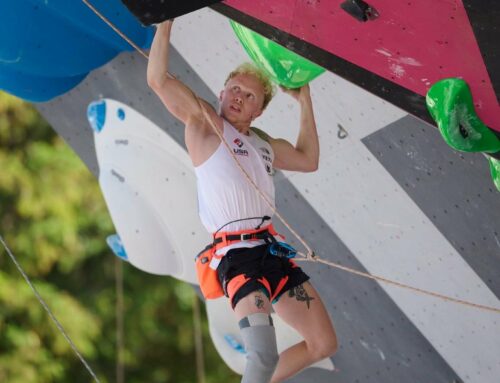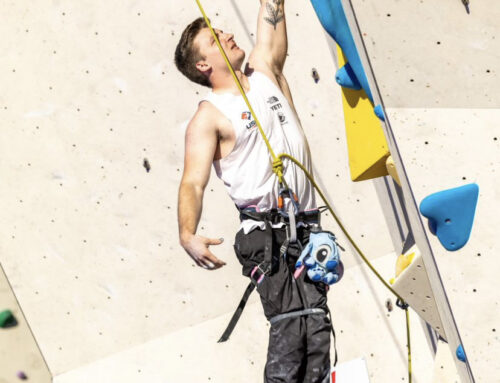


Ukrainian veteran on the wall in Kamianets-Podilskyi, Ukraine.  Tristan Blommer
Climbing Together in Ukraine
By Alex Kosseff, Executive Director, Paradox Sports
At 9 a.m. every day, Ukraine pauses to remember those killed defending their country. In the cities we visited, memorials to fallen soldiers filled public spaces, and air raid alerts were part of daily life. Later, we heard laughter at the climbing wall, watched someone work through a difficult move, and saw new friendships take shape. Both were part of life around us.
In August, our Paradox Sports team spent five days in Ivano-Frankivsk and Kamianets-Podilskyi helping Ukrainian climbers build adaptive climbing opportunities for veterans with disabilities. Thirty-five people took part in some or all of the training. They included veterans, instructors from climbing gyms in Dnipro, Kyiv, Ivano-Frankivsk, and Lviv, leaders of veterans’ outdoor programs, and staff from a rehabilitation center. Many were already skilled climbers. They wanted practical knowledge they could use in their own communities.

Practicing rope ascension. 📸 Anastasiia Kubert
This work began with Razom for Ukraine (razom means “together” in Ukrainian). Razom saw the need, brought partners together, and invited Paradox to share what we have learned from nearly 20 years of adaptive climbing. Its support made the training possible. From the start, the goal was for Ukrainian instructors and organizations to develop programs that would continue long after our team returned home.
We began in the gym, working through adaptive techniques, disability awareness, belay systems, and ways to welcome climbers with a wide range of injuries and experiences. Then we took those skills outside to the rock. Participants tried climbing with prosthetics, systems that assist while a climber makes their own moves, and rope ascension techniques for individuals with limited mobility. Just as important, instructors practiced listening to each climber and adapting their approach.
One person we met was Yurii, a veteran and climbing instructor in Ivano-Frankivsk. He told Suspilne, Ukraine’s public broadcaster, that he wants to use what he learned to bring other veterans out of their homes and into the climbing community. His ambition captures why this training matters. Climbing offers a physical challenge, but it also gives people a place to show up, trust one another, and be known as climbers and teammates.
Our co-founder DJ Skelton, a wounded U.S. veteran, has helped shape this approach since Paradox began. He knows that adjusting to life after injury is rarely something a person can do alone. His experience is different from that of Ukrainians living through this war. Yet the climbing community’s willingness to offer a belay, solve a problem together, and make space for someone new crosses borders. DJ helped bring this project together and joined me in Ukraine alongside Sam Sala, our national program manager, and Tristan Blommer, our photographer and videographer.

Climber using a mechanical advantage system. Anastasiia Kubert
The war was never far from our conversations. We met people whose loved ones had been killed, whose homes were destroyed, and whose families were displaced. Many live with nightly missile and drone attacks. The scale of loss is difficult to comprehend, and there is no clear date when the need for support will end. Our Ukrainian partners understand that they cannot wait for the war to end before building opportunities for veterans to reconnect with their bodies, their friends, and the outdoors.
I have traveled widely for work, and I have never felt more warmly welcomed. The determination of the veterans and climbers we met was extraordinary, as was their generosity with us and one another. Over five days, the group became more than a collection of people taking a course. The goodbyes were hard: there were gifts—a Ukrainian tradition—hugs, tears, plans to climb together again, and hopes for peace.

Part of the training group at Zachipka Climbing Wall Tristan Blommer
We are grateful to Razom for Ukraine and to our Ukrainian partners Petros veterans hub, Second Wind veterans outdoor program, and Zachipka Climbing Wall, along with the many instructors and volunteers who made the week possible. The Petzl Foundation provided more than $6,000 in equipment used during the training and left in Ukraine for future veterans’ programs, while The North Face provided additional support, including packs from their Universal Collection. In addition to Ukraine’s public broadcaster, GearJunkie shared the story in the United States, and in Ukraine’s neighbor, Poland, Wspinanie (“climbing” in Polish) covered the project.
The course was a beginning. In a group discussion, Ukrainian participants identified grassroots programs based at climbing gyms and local crags as a place to start. Razom has asked us to explore further trainings in 2027, with the goal of developing a cadre of Ukrainian instructors to teach adaptive climbing skills across the country. We are working with our partners on what those next steps could look like. We’re thrilled to put the adaptive equipment and skills in capable Ukrainian hands.
Ukraine’s veteran and climbing communities are doing this work amid a horrific war. We were fortunate to join them for a week. I came home thinking about the resolve it takes to create something generous and hopeful while facing so much loss—and about the responsibility we have to keep showing up for the people who welcomed us.
Photos from the training


Click on gallery images to enlarge them. Images by Anastasiia Kubert, except for image two, by Tristan Blommer.